It’s gone eleven, the house is quiet, and then it starts: the steady thud of a helicopter somewhere overhead. Sometimes it passes straight through. Sometimes it hangs over the same few streets for what feels like an hour.
And every time, someone on a local Facebook group asks the same thing: why is there a helicopter over Pontypridd tonight, and what’s it doing over Rhydyfelin?
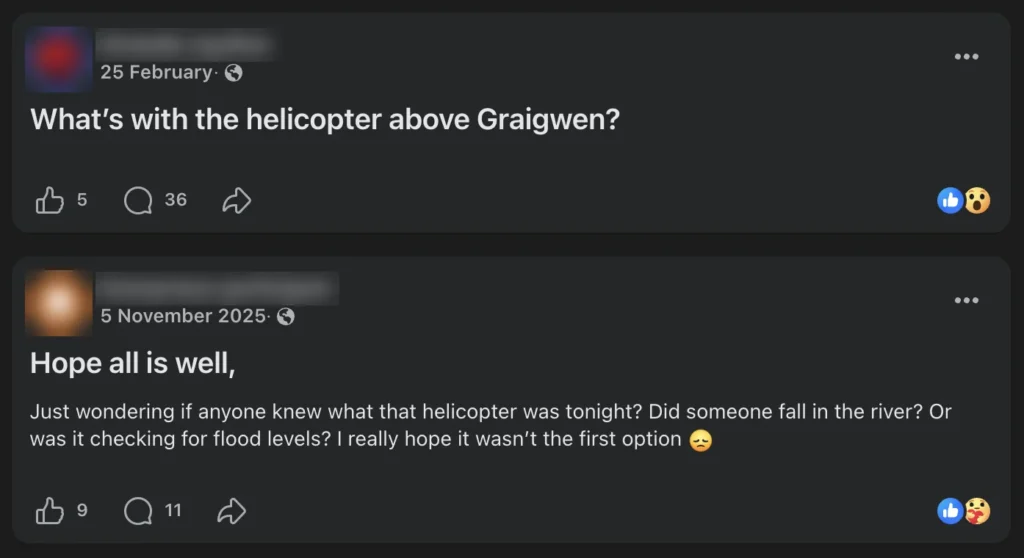
We can’t tell you what any particular helicopter was doing, and often nobody will. But only a handful of helicopters fly over this part of the Taff valley at night, and with a few clues you can usually work out which one it is and roughly why it’s there. Here’s how, along with how to find out more and who to contact if the noise or low flying bothers you.
Which helicopters fly over Rhydyfelin at night?
After dark, a helicopter over the village is almost always one of these three. Military training is a fourth possibility, further down.
The police helicopter (NPAS St Athan)
Police forces in England and Wales don’t have their own helicopters any more. They share the National Police Air Service(opens in a new tab) (NPAS), and the base for South Wales is NPAS St Athan(opens in a new tab) in the Vale of Glamorgan. When South Wales Police needs eyes in the sky over Rhydyfelin, this is usually where the helicopter comes from, although aircraft from other bases can cover too.
NPAS says officers have to show there’s a significant threat, risk or harm before air support is sent, so a police helicopter isn’t sent on a whim. The NPAS FAQs(opens in a new tab) list the kind of work it does: searching for missing or vulnerable people, following suspects and vehicles, sending live video to commanders on the ground and gathering evidence. At night the crew relies on a thermal imaging camera, which picks out a warm body against cold grass, gardens and rooftops. That’s why a police helicopter will often circle over one area for a long time. It’s searching, or keeping watch while officers on the ground get into place.
Wales Air Ambulance
Wales Air Ambulance(opens in a new tab) is a charity that flies critical care teams to seriously ill and injured people, working with the NHS’s Emergency Medical Retrieval and Transfer Service (EMRTS). It has four H145 helicopters, based at Dafen near Llanelli, Cardiff, Welshpool and Caernarfon. It says it attended 3,665 missions in 2025.
So does it fly at night? Yes. Since December 2021, the Cardiff base has run 24 hours a day(opens in a new tab), with night operations from 7pm to 7am. Night crews fly with night vision goggles. Critical care staff at the EMRTS hub in Cwmbran monitor every 999 call made in Wales and decide when to send a team. At night the helicopter needs about twice as much clear space to land as it does by day, so if it’s coming down nearby, it’ll look for a big open area such as a playing field or park.
HM Coastguard search and rescue
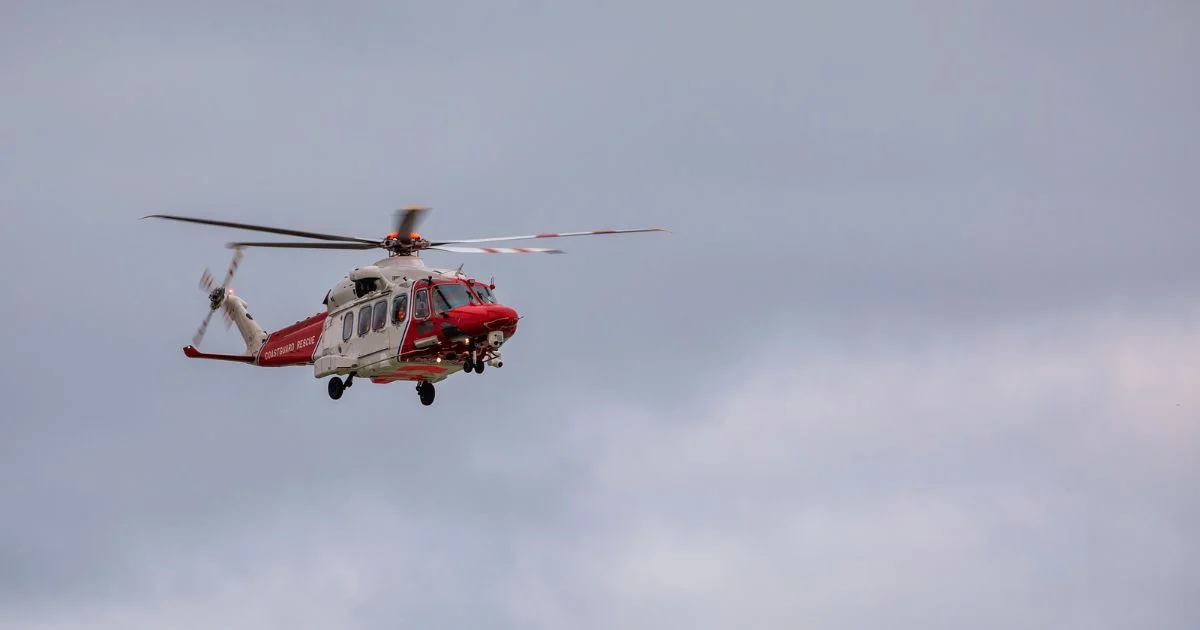
Rhydyfelin is a long way from the sea, but the coastguard helicopter isn’t only for the coast. HM Coastguard(opens in a new tab) runs search and rescue helicopters from ten bases around the UK, and one of them is at St Athan. They’re operated for HM Coastguard by Bristow, and as well as rescues at sea and along the coast, they’re called inland when a helicopter is needed, such as for mountain rescues. The St Athan base now flies an AW139, according to the government’s December 2025 search and rescue update(opens in a new tab).
If someone is lost or hurt on the hills above the village, it could be the coastguard helicopter you hear. Our beginner’s guide to walking on the hill above Rhydyfelin explains how to stay out of that situation in the first place.
Military helicopters
The armed forces train in low flying across the whole of the UK. According to the Ministry of Defence(opens in a new tab), the UK low flying system covers open airspace from the ground up to 2,000 feet, and helicopters are allowed to fly very low within it. So a military helicopter passing over the valley is possible, though it’s far less likely than the three above to be hovering over the village late at night.
How to tell them apart
At night you’ll usually only see lights, so how the helicopter behaves is often a better clue than what it looks like.
- Circling or hovering over the same streets for a long time: most likely the police helicopter, searching with its thermal camera or watching while officers on the ground do their job. A search for a missing person can look exactly the same.
- Flying fast and straight, then gone: often the air ambulance on its way to or from an emergency or a hospital, or any of the others passing through to a job somewhere else.
- Coming down low over a playing field or open ground: most likely the air ambulance landing near a patient. It’s a sign that someone nearby needs urgent care, so keep clear and keep the area free for the crew.
- Working slowly over the hillside, the river or the woods: could be a search for someone missing or a rescue, by the police or the coastguard.
If you see one in daylight or under street lights, the colours help:
- Police (NPAS): yellow on top and blue underneath. NPAS says the yellow helps other aircraft see it from above, and the blue is for being seen from below. It flies EC135 and EC145 helicopters.
- Wales Air Ambulance: bright red.
- HM Coastguard: red and white, in HM Coastguard colours.
Every civil aircraft registered in the UK, including the police, air ambulance and coastguard helicopters, carries a registration starting with G. If you can read it, or a flight tracker shows it, you can look it up on the CAA’s register.
How to find out what the helicopter was doing
Sometimes you can find out, often you can’t. Police jobs are directed by the local force, and live incidents, especially ones involving vulnerable or missing people, usually aren’t explained while they’re happening. A few places to look:
- South Wales Police (@swpolice) sometimes posts appeals or updates on its social media accounts, especially if it needs the public’s help to find someone. If there’s an appeal for a missing person, that’s the post to share.
- NPAS posts about some of its work on X as @NPAShq(opens in a new tab) and on its other accounts. NPAS says these aren’t monitored around the clock, so they’re not the place to report anything.
- Wales Air Ambulance shares news on Facebook and as @air_ambulance(opens in a new tab) on X and Instagram. It says it can’t comment on ongoing incidents.
- Local Facebook groups are often the quickest place to hear that a road’s been closed or something’s going on. Our list of Facebook groups to join if you live in Rhydyfelin has the main ones. Treat rumours with care, and never share details or photos of people involved.
Can I see it on a flight tracker?
Sometimes. Apps and websites such as Flightradar24 and ADS-B Exchange show aircraft whose transponders broadcast their position. There are limits, though. Flightradar24 says(opens in a new tab) an aircraft’s owner or operator can ask for it to be blocked, and police and military aircraft are often missing from the mainstream apps. Low-flying helicopters can also drop out of range of the receivers that feed these sites, especially down in a valley like ours. The air ambulance and coastguard helicopters are more likely to show up than the police helicopter, but nothing’s guaranteed. Even when a tracker shows you where a helicopter went, it won’t tell you why.
Should I call 999 or 101?
Please don’t ring 999 just to ask what the helicopter is doing. Emergency lines need to stay free for emergencies. But do ring 999 if you know something that matters right now: if you’ve seen the person or car being searched for, if you can see someone in danger, or if a crime is happening. If you have information that isn’t urgent, call 101, the police non-emergency number, or report it online through the force’s website. If there’s a missing person appeal and you think you’ve seen them, ring straight away.
Noise, low flying and privacy
A helicopter overhead at two in the morning is no fun, especially with a baby, a shift worker or a nervous dog in the house. Here’s what the rules say.
How low are helicopters allowed to fly?
Under the Civil Aviation Authority’s rules for flying at night(opens in a new tab), an ordinary aircraft has to stay at least 1,000 feet above the highest obstacle within 600 metres when it’s over a town or village, and more than 500 feet above the ground elsewhere.
Emergency services are treated differently. The CAA has issued general exemptions from those minimum heights for police flights(opens in a new tab), air ambulance (HEMS) flights(opens in a new tab) and search and rescue flights(opens in a new tab). For the air ambulance, the pilot may only go lower than the normal rules allow as far as the job needs. So a police or air ambulance helicopter that seems very low over the rooftops is probably flying within the rules. NPAS also says its crews fly higher at night to keep the noise down.
Is the police helicopter filming me?
The police helicopter’s cameras are there to find people and to record evidence of crime, and NPAS lists evidence gathering among its jobs. NPAS says officers have to request it for a specific incident, through its operations centre. If you think the police have used the helicopter wrongly, you can make a complaint (see below).
Who to contact about noise or low flying
- The police helicopter: NPAS takes complaints about its service in writing. The address and email are on its complaints page(opens in a new tab). For general questions, it handles Freedom of Information requests through West Yorkshire Police, the force that runs NPAS.
- Wales Air Ambulance: see the charity’s complaints page(opens in a new tab). It points operational complaints to EMRTS Cymru.
- Military aircraft: the MOD’s Low Flying Complaints and Enquiries Unit, on [email protected] or 01780 417558 (Monday to Friday, 8am to 4pm). Give your name, address and postcode, phone number, the date and time, where it happened, the type of aircraft if you know it, and a short description. The MOD says you should hear back within 20 days(opens in a new tab).
- Any other civil aircraft: the CAA says that if an aircraft isn’t breaking the Rules of the Air, it has no legal power to restrict it, and suggests contacting the operator first. You can also send it a concern about noise or low flying using the form on its aircraft noise page(opens in a new tab). The CAA has no authority over military aircraft.
Make a note of the date, the time, how long it went on and where you were. It makes any complaint much easier to look into.
Helicopters at night: quick answers
Why is a helicopter circling over Rhydyfelin at night?
A helicopter circling over the same area at night is most likely the police helicopter from NPAS St Athan. It may be searching for a missing person or a suspect with its thermal camera, or watching over an incident while officers on the ground deal with it.
Does the Wales Air Ambulance fly at night?
Yes. Wales Air Ambulance has flown 24 hours a day from its Cardiff base since December 2021, with night operations from 7pm to 7am. Its crews use night vision goggles.
Where is the police helicopter for South Wales based?
The National Police Air Service base for South Wales is NPAS St Athan, in the Vale of Glamorgan. Helicopters from other NPAS bases can also cover the area.
How can I find out what a helicopter was doing?
Check South Wales Police, NPAS and Wales Air Ambulance on social media, where they sometimes post appeals or updates. Flight-tracking sites may show air ambulance and coastguard helicopters, but police aircraft are often hidden, and live police jobs usually aren’t explained.
Should I call the police about a helicopter?
Only if you have information. Call 999 if you’ve seen the person or vehicle being searched for, or someone is in danger. Call 101 or report online for anything that isn’t urgent. Don’t call 999 just to ask why the helicopter is there.
Who do I complain to about helicopter noise?
For the police helicopter, write to the National Police Air Service. For military aircraft, contact the MOD’s Low Flying Complaints and Enquiries Unit. For other civil aircraft, contact the operator or the Civil Aviation Authority. Emergency service helicopters are allowed to fly lower than other aircraft when the job needs it.
So next time the windows start rattling, there’s a good chance someone, somewhere nearby, is having a much worse night than you. If you know something that could help, ring it in. If not, pop the kettle on and try to get back to sleep. For more on who to call when something’s wrong in the village, see our guide to reporting problems in Rhydyfelin.